EMT Practice Test

1. Question Content...


Question List

Question1: In a Lean Software Development environment, the Project Leader strives to eliminate:

Question2: A common estimation unit for Agile projects is:

Question3: Which of the following would be most likely to assist when a customer has difficulty prioritizing stories?

Question4: The best approach to estimate the work on a project when using story points is to have:

Question5: What is the best description of the relationship between Scrum and extremeProgramming(XP)?

Question6: What is the common communication bridge between the team and the Product Owner?

Question7: Which three criteria should be looked at when setting iteration length?

Question8: What do project reports show during the Sprint review meeting?

Question9: Refactoring, as it applies to the practice of extreme Programming (XP), refers to:

Question10: The smallest amount of functionality that delivers customer value is best described as a:

Question11: Which of the following drivers is the most important factor in determining the order in which stories will be developed?

Question12: Team velocity is used to:

Question13: Acceptance tests of user stories are specified by the:

Question14: The advantage of face-to-face collaboration emphasized in eXtreme Programming (XP) is that it:

Question15: The ScrumMaster notices repeated friction between two team members in the Daily Scrum meetings. The next step should be to:

Question16: When are acceptance tests typically written for a user story?

Question17: On a team new to Scrum, two team members are disrupting the daily standup with a side conversation.
The ScrumMaster should:

Question18: In Agile projects, the technique in which planning is done at three distinct horizons is known as:

Question19: According to the Agile Manifesto, which of the following describes the more valued items?

Question20: Agile project development processes typically:

Question21: Which of the following is a list of valid Agile project planning practices?

Question22: The primary purpose of a Sprint retrospective is for the team to:

Question23: What is the ideal approach for an Agile project manager to take when considering fractional assignments?

Question24: After three iterations, the problems impeding an Agile team appear to be similar in nature to problems faced in earlier iterations. Inspection of the retrospectives for past iterations reveals information organized into columns entitled "What worked for us" and "What did not work for us. " Based on this information, one can infer that the team did not capture:

Question25: For a "caves and commonroom arrangement, the most appropriate prerequisite is that the people in the room must be working on:

Question26: A project team is distributed across multiple countries, and they are having issues agreeing on what is being delivered and how it should be developed. Which of the following should the project manager do to alleviate some of the tension between team members, break down cultural barriers, and improve communication?

Question27: Which technique is used by a project team to estimate the amount of work that can be done per iteration?

Question28: The most powerful capability of Scrum teams is that they:

Question29: In reference to Scrum, each sprint should produce:

Question30: Agile Earned Value Management (EVM) would be a valuable technique for managing a project because the:

Question31: Who is responsible for making sure that each user story is associated with at least one user role or persona?

Question32: In the Lean process, the focus is on:

Question33: Which of the following is most appropriate to always participate in Planning Poker?

Question34: In Agile projects, how are planning outputs shared with stakeholders?

Question35: The Kaizen philosophy is change:

Question36: The three questions asked at every Daily Scrum should be: "What have you accomplished since the last Daily Scrum?";"What are you planning to accomplish between now and the next Daily Scrum?"; and:

Question37: When facilitated and managed well, the primary benefits of a project retrospective should be to:

Question38: The velocity chart, storyboard, burndown chart, and impediment list are often communicated using:

Question39: Which tool allows the Product Owner to focus on providing the greatest value and Return on Investment (ROI) to the organization?

Question40: How does Empirical Process Control support Agile methodologies?

Question41: For the best results in an Agile project, customers should:

Question42: What key benefits might stakeholders realize from an Agile approach?

Question43: What are the primary outputs of a release planning session?

Question44: Which of the following techniques best encourages osmotic communication?

Question45: On what should Agile estimates be based?

Question46: Team A is producing 61 points per iteration and Team B is producing 20 points per iteration. Team A has more senior engineers. A manager demands that Team B match Team A's points in the next iteration.
Based on this information, it is reasonable to tell the manager that:

Question47: Retrospectives provide an opportunity for the team to:

Question48: When an Agile project team receives an "emergency request" during an iteration, which is the best first step that the Agile project manager should take?

Question49: When is the ideal time to hold a retrospective?

Question50: Which of the following is part of the 12 practices defined in eXtreme Programming (XP)?

Question51: An Agile team best ensures product quality through:

Question52: A business analyst has identified a new risk in an Agile project. What is the best first step the business analyst should take regarding this risk?

Question53: What are three processes used to begin an Agile project?

Question54: Which of the following is a list of capabilities, features, and stories that the Product Owner has identified?

Question55: A value stream map is a tool used to identify the:

Question56: Which layer of the product planning structure defines details at the capability or feature level?

Question57: Velocity is the:

Question58: A full cycle of design-code-verifyrelease practiced by extreme Programming (XP) teams is called:

Question59: Since the last iteration, the team has grown from six members to 14 members. As a result, in the current iteration, the team room is crowded and uncomfortable during the team's daily standup. It takes the team longer than the ideal amount of time to complete their standup, which creates problems for the team's current schedule. Based on this information, the project manager should:

Question60: Which of the following is an example of a visual aid used in Lean-Agile software development?

Question61: Who is responsible for prioritizing the stories that will be included in the iteration?

Question62: Which of the following best describes a core belief of Agile?

Question63: Scrum practices are facilitated by the:

Question64: The best reason for extreme character personas in writing user stories is to:

Question65: At a strategic level, what is the most appropriate way for an Agile team to estimate a project?

Question66: A common reason that a story may not be estimable is that the:

Question67: A story point is the:

Question68: When moving to Agile project management, a key factor for the project manager's success will be:

Question69: What is the role in an eXtreme Programming (XP) project that ensures the right project processes are applied?

Question70: A development team has finished identifying the tasks they will be accountable for during the next sprint.
Which of the following tools best provides transparency into the progress throughout the sprint?

Question71: Agile communication is effective because:

Question72: A high-performance Agile team:

Question73: The purpose of the iteration retrospective is to:

Question74: The most appropriate model for a geographically distributed project team is one in which the team is distributed across:

Question75: According to the fundamental principles of Lean Management, errors result from:

Question76: In an Agile approach, project values are most effectively implemented when they are determined by the:

Question77: Collaboration can be defined as working together to jointly produce a deliverable or make a decision, whereas coordination is:

Question78: Which are some of the most important benefits of an Agile team sitting together in a co-located, open environment?

Question79: Which type of estimate refers to estimating a story based on its relationship to one or more other stories?

Question80: Which type of story would be used when an estimate is not available due to lack of knowledge of the technology required to implement the story?

Question81: A project team estimates that they should complete 30 story points in the current iteration. Partway through the iteration they realize that they will complete 50 story points at their current rate. The team should:

Question82: A ScrumMaster consistently holds Daily Scrums and keeps them to 15 minutes or less. The ScrumMaster brings a list of assigned tasks and checks the status of each task with the relevant team members. The ScrumMaster then assigns new tasks for the day and ends the meeting. Is this an appropriate approach to running Daily Scrums?

Question83: The key elements of a user story in Agile development are:

Question84: Applying the Pareto rule when prioritizing the Product Backlog means that:

Question85: Which management style does Agile advocate?

Question86: Which of the seven principles of software development is best intended to solve the problem of inventories causing hidden errors in the process?

Question87: What is one of the main benefits that Lean portfolio management provides to a business?

Question88: In eXtreme Programming (XP), analysis, design, coding, and testing phases are done:

Question89: Which answer best describes Wide Band Delphi (e. g. Planning Poker) estimating?

Question90: When interacting with team members, the Agile project manager should:

Question91: The cost estimation techniques used on Agile projects are:

Question92: Test-Driven Development (TDD) is a rapid cycle of:

Question93: Continuous integration ensures that a product is:

Question94: A user story says that a product must be very fast. During the demo, the Product Owner is dissatisfied with the speed of the product. The most likely reason that this occurred is because the user story was:

Question95: The term ¡°last responsible moment¡± refers to the moment at which:

Question96: Which best describes the attributes of the IN VEST criteria in a user story?

Question97: When developing user stories, user expectations are best captured in what form?

Question98: Who is responsible for determining the business value of each feature?

Question99: During which activity is the sequence of numbers 0, 1, 2, 3, 5, 8, 13 often used?

Question100: What is the responsibility of an extreme Programming (XP) customer role?

Question101: The purpose of "setting the stage'' in a project retrospective is to:

Question102: The primary purpose of a Sprint Review is for the team to:

Question103: What is the first thing that a team should do to estimate user stories for a project?

Question104: During iteration planning, the team is discussing the design for a user story. A team member states that a design document should be started since the system is complex in nature. Another team member responds that in Agile there is no documentation. How should the ScrumMaster respond?

Question105: Estimating costs for an Agile project starts with which of the following types of meetings?

Question106: Spike solutions are appropriate when:

Question107: The ScrumMaster and the Product Owner disagree on the value of a Product Backlog item. In order to resolve the disagreement, the first step the ScrumMaster should take is to ask:

Question108: eXtreme Programming (XP) teams strive to avoid:

Question109: Project managers use velocity to determine:

Question110: A ScrumMaster:

Question111: User stories are temporary artifacts. They are considered relevant until the:

Question112: Following chart lists stories for a release of an Agile project;

If the team completes Story A, Story B, and 50% of Story C for the first iteration, what is the team's velocity?

Question113: When using Agile Earned Value Management (EVM), progress should be measured at which level?

Question114: During the daily standup meeting, a team member states that an issue has been encountered. This leads to the team members getting into a problem-solving discussion. How should the ScrumMaster respond?

Question115: On a project using eXtreme Programming (XP), a customer test is a:

Question116: What is used to provide a simple medium for gathering basic information about stories, recording high-level requirements, developing work estimates, and defining acceptance tests?

Question117: Which of the following statements is an accurate value statement of the Agile Manifesto?

Question118: The team estimation game method mainly consists of a:

Question119: The process of reviewing, testing, and accepting implemented features is called:

Question120: In an Agile approach, at which meeting does a team examine the effectiveness of risk responses by conducting a risk audit?

Question121: A technique showing Kanban work stages by comparing counted features over a time interval is called a/ an:

Question122: Information transmission is greatest amongst team members who are working on:

Question123: A company is starting to introduce Agile practices, and the project manager has been asked to identify how to introduce the new process. The project manager's initial plan should be to:

Question124: For a critical project, a new team has been formed from various departments. The project manager should start team building by:

Question125: Which of the following is critical for the success of distributed Agile teams?

Question126: An Agile team expects a velocity of 8. During sprint planning, the stories were estimatedand prioritized in the following order:
Story A_4Story Points
Story B_2Story Points
Story C_3 Story Points
Story D_2Story Points
Which stories should the team include in Sprint 1, without splitting the stories?

Question127: How is the participatory design process characterized?

Question128: Who is responsible for the "definition of done"?

Question129: What is one of the benefits of incremental delivery?

Question130: In a vision meeting, the vision for the project is defined and presented by the:

Question131: A "Scrum of Scrums" meeting is:

Question132: When estimating initial velocity, the team should most likely:

Question133: Which is the best option to improve project velocity?

Question134: The best description of the purpose of the daily standup in Agile projects is to:

Question135: In Agile risk management, a risk burndown chart is best used to:

Question136: The following chart lists stories for a release of an Agile project:

If the velocity of the team is 10, how many iterations will be needed to complete all of the stories?

Question137: What is a high-level representation of the features or themes that are to be delivered in each release?

Question138: Which of the following best represents both a principle of the Agile manifesto and a Lean method of simplicity?

Question139: In a Lean project environment, visual controls:
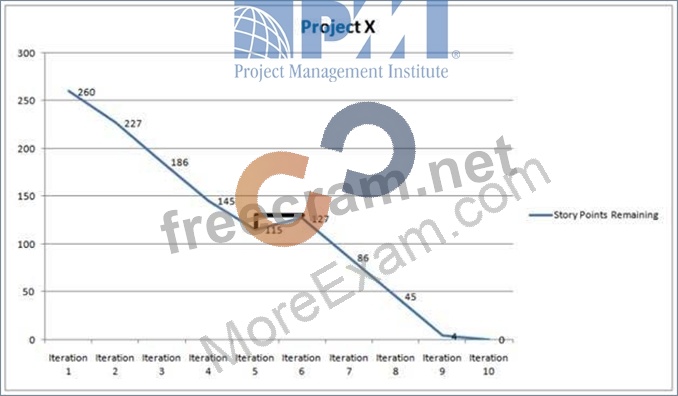
Question140: Based on the following figure, during Iteration 5, there was an increase in story point value (shown on the graph); however, the team completed all of the work it promised to deliver in the iteration and existing estimates were not changed. From this information, one can inferthat:

Question141: An organization adopts Agile practices and implements an incremental delivery strategy. If implemented correctly, the company should recognize improved:

Question142: Risk exposure is the:

Question143: On a particular project, product quality is being measured at regular intervals and is consistently below the acceptable level. In a Lean environment, how should this problem be addressed?

Question144: The purpose of a project burndown chart is to:

Question145: Which term best describes an Agile project's approach to risk analysis?